How I Approach a 100 km Road Race
A 100 km road race sits in an awkward spot in amateur racing: it's long enough that going hard from the gun is a strategy you'll regret by kilometre 40, but short enough that there's no real "second half" — the race is decided by decisions, not by who has the biggest engine. After a few seasons of them I've settled on an approach that's about as unglamorous as it gets: build the base in training, fuel like it's part of the ride, and stay patient until the last 20 km.
Training for it: one block at a time
I don't train "for 100 km" all season — I build a 4–6 week block before each target race, and the shape is boring on purpose:
- Aerobic base stays the floor. Most of the weekly volume is easy riding, even inside the specific block. The race itself will be hard; the training around it doesn't need to match.
- Two threshold sessions a week — intervals at the edge of comfortable, nothing more. That's where 100 km races are actually won: not in the sprints, but in the repeated surges and the pace someone holds when the bunch settles.
- One long ride a week in race kit, with the nutrition I plan to use on race day. If a bar makes me sick at kilometre 60 of training, it will absolutely make me sick at kilometre 60 of a race.
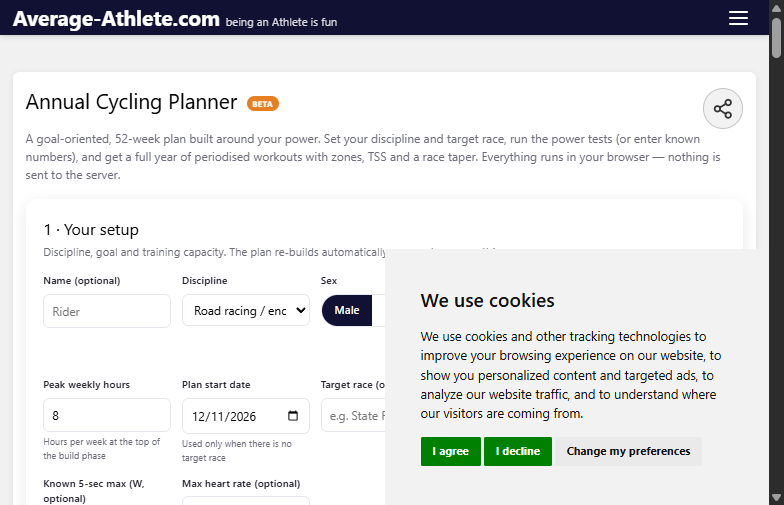
I plan the block in the cycling planner on this site — power test up front, zones from that, then periodised workouts week by week. It's still in beta, but it's where my own plans live now.
The fueling plan (the part everyone gets wrong)
The rules I ride by:
- Eat before you're hungry. By the time hunger registers, you've already started running on reserves — and at 100 km you don't get to refuel with a sandwich at a café.
- Practise the rate, not just the products. I aim for roughly 60–90 g of carbs per hour in race conditions, split across bottles, gels and bars. The exact number matters less than my gut having done it before.
- Drink on a schedule, not by thirst. A bottle every 15–20 minutes keeps hydration from becoming a decision mid-race.
- First feed zone is non-negotiable. Most of the faded riders I've seen in these races trace back to skipping early fueling because "we're only 15 km in."
For a typical 2.5–3 hour 100 km I carry two bottles plus two or three solid feeds, and I treat the plan as part of the race kit, not an afterthought.
Gear: comfort beats watts over 3 hours
Aero gear is fun to talk about, but at amateur speeds the difference between a deep-section wheelset and a sensible 50 mm one is small compared with what your back and hands will cost you over three hours. What I actually spend money on for a 100 km:
- Position — something I can hold without white knuckles. A slightly higher bar than my race tuck, always.
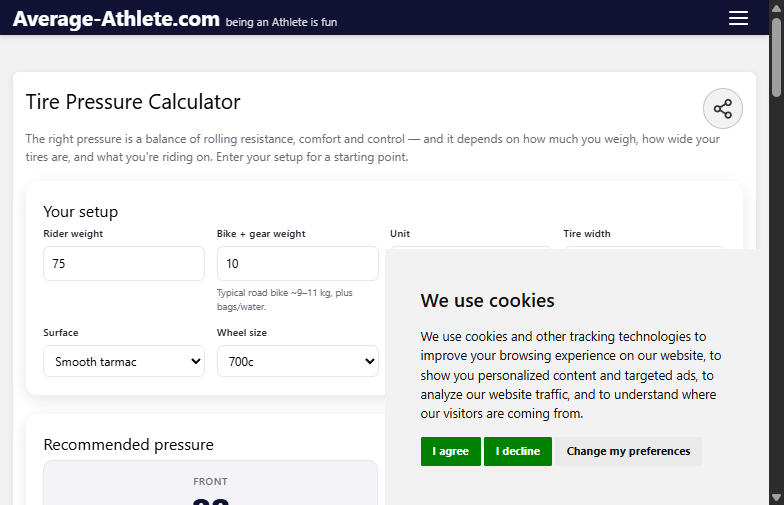
- Tires — the biggest comfort-per-dollar win available. I estimate pressure from total system weight and tire width with the tire pressure tool on this site rather than guessing off the sidewall range.
- Bottles that fit and a saddle I've already broken in — never new kit on race day, full stop.
Race day: three sections
I split the race into three sections in my head:
- First 20 km — stay patient. Everyone is fresh and everyone wants to be at the front. I hold a good position without burning matches; the goal is to be in the top group, not to win the first round.
- Middle 60 km — execute the plan. Fuel on schedule regardless of how the race feels, drink on schedule, watch for crosswinds and the odd attack. This is where the training shows: holding position without it costing you.
- Last 20 km — now race. Whatever's left in the tank goes here. If I've fuelled properly there is something left; if I haven't, no amount of tactics fixes an empty tank.
The bottom line
A 100 km road race is won in training and lost on nutrition — the actual racing is only the last part. Build the block, practise the fueling, stay patient for two hours, and you'll be in the mix when it counts. That's what this site is for — race reports, training notes and gear takes from an average athlete: average-athlete.com.