Winding Down After Race Days: Sleep Is Recovery (and a Free Tool I Built for It)
Everyone chases recovery in the obvious places — nutrition, ice baths, the easy spin the next morning. But the single biggest recovery tool is the one you already use every night: sleep. And here's the thing nobody tells you — race nights are the hardest nights to actually get it. Your body just spent two hours in overdrive, and now you're lying in bed replaying the last 200 metres while your heart rate refuses to come down.
Why sleep is where recovery actually happens
You don't get stronger on the bike. You get stronger in the bed, after the ride:
- Deep sleep is when repair work happens. Growth hormone release peaks in deep (slow-wave) sleep — that's when the micro-tears from a hard session start getting rebuilt.
- Reaction time and decision-making are sleep-sensitive. The first thing that degrades with a short night isn't your legs, it's your brain — exactly the part you need for a breakaway or a bunch sprint.
- Immunity follows sleep. A week of 6-hour nights after a race block is how athletes pick up bugs.
The research side is unambiguous: consistent, quality sleep is a training variable, not a luxury. The problem for us is that the days we most need it — race day, hard track session, 100 km road race — are the days our nervous system is least cooperative.
Why race nights wreck your sleep
After a race your body is still in "beta" — the alert, racing state. Adrenaline and cortisol are still circulating, your heart rate is elevated, and your brain is doing what brains do: replaying every mistake, every gap, every wheel that came up. Add a phone screen to that (congratulations, you just told your brain it's 3 pm) and falling asleep turns into an event.
The fix isn't complicated, it's just boring — which is why it works:
- Same bedtime, every night — including race nights. Your circadian rhythm is a habit, and habits don't like surprises.
- Dark and cool room. Darkness drives melatonin; a cool room helps core temperature drop, which is part of the sleep signal.
- Screens off or dim an hour before bed. If you can't put the phone down, at least make it dark mode and face-down.
- Something steady to hold onto. A rhythm — breath, sound — gives the "racing" mind a place to park instead of free-associating through the day's results.
Point 4 is where my other project comes in.
The tool I built for exactly this: quietdeep.app sleep mode
I build software for a living, and I got tired of sleep apps that wanted a subscription, an account, and your data before they'd play a sound. So I built quietdeep.app — a free meditation and sleep app that runs in your browser (or installs as a PWA), no account required.
The sleep mode is the part I use after race days:
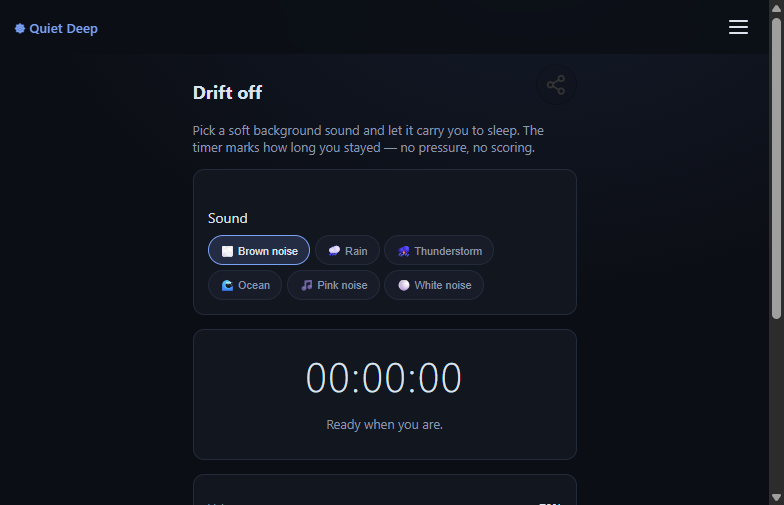
- Soft background sounds — rain, thunderstorm, ocean, brown, pink or white noise — synthesised live on your device, so there's nothing streaming and nothing to buffer.
- A rest timer. You pick a duration, it runs quietly, and when it ends it just marks how long you stayed — no pressure, no scoring, no guilt if you woke up at minute 40.
- Theta entrainment (the "meditate" side of the app) uses binaural beats and isochronic tones in the 4–8 Hz band to give your brain a steady rhythm to settle onto — headphones for binaural, any speaker for isochronic.
How I use it on race days
My routine on a race night is simple: shower, proper dinner, phone away around 9:30, then quietdeep's sleep mode with rain at low volume and the timer set for 45–60 minutes. The sound doesn't have to be loud — the point is that it's steady, so my brain has one thing to attend to instead of the last round. On really racy nights I'll do a short meditate session first (binaural, headphones) just to burn off the edge, then switch to sleep mode.
It's free, it works offline (it's a PWA — no signal in the caravan? still works), and because everything is generated on your device there's nothing of yours being uploaded anywhere. If you want your sessions and stats to follow you across devices, or daily reminders to build the habit, create a free account here — it's still free, it just syncs.
Bottom line
You can't out-recover a bad night with an ice bath. Protect the sleep like it's part of training — because it is — and give your racing brain somewhere to land when the day has been big. The tool's free if you want it: quietdeep.app.